Putting the Brakes on Global Antimicrobial Resistance

“[T]he world faces a double challenge—while some antibiotics are being overused, millions of people still lack access to medicines they need to treat their bacterial infections."
Aislinn Cook, City St. George’s University of London
“Of all the areas of drug development that artificial intelligence has the potential to transform, antibiotics may be the most consequential.”
Cesar de la Fuente-Nunez, Presidential Associate Professor, University of Pennsylvania
Many infectious diseases specialists see antimicrobial resistance (AMR) as the single biggest emerging infectious disease threat. Already associated with more than 1 million attributable deaths per year, AMR is forecast to cause about 39 million deaths worldwide between 2025 and 2050. (Naghavi, M., et al., “Global burden of bacterial antimicrobial resistance 1990-2021: a systematic analysis with forecasts to 2050,” The Lancet, September 28, 2024). It is a global threat to public health.
I’ve raised the alarm about the serious consequences flowing from AMR in many of my previous Germ Gems posts. This week, I briefly review the magnitude of the problem and point to strategies that could be used to stop this growing pandemic.

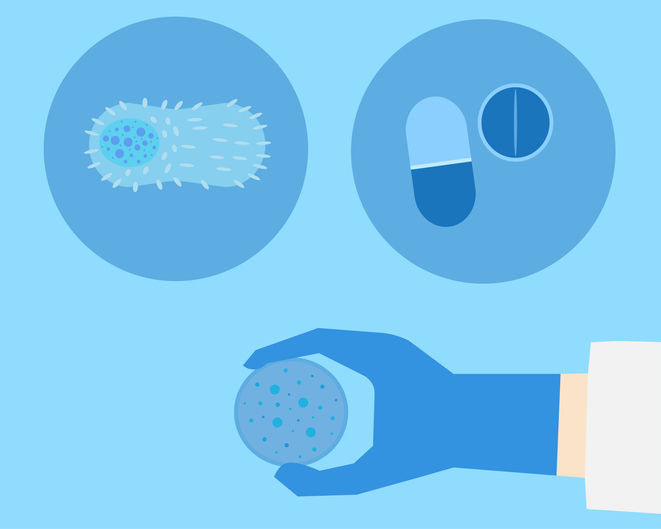
What are antimicrobials and what is AMR? Many microbes (bacteria, fungi, viruses, and parasites) live in milieus that are not conducive to their survival—including the human body. A major threat to their existence is posed by antimicrobial agents, a general term for anything that inhibits or kills the microbes. Antimicrobial medications include: antibioticswhich target bacteria; antifungals which target fungi; and antivirals which target viruses.
AMR occurs when these microbes, be they bacteria, fungi or viruses, evolve so they are no longer affected by the antimicrobial medicines that were developed to target them. While it is a natural, ongoing, evolutionary process, human activity has accelerated it, specifically the overuse and misuse of antibiotics in human medicine and in agriculture.
Antibiotic misuse/overuse. Antibiotics target bacterial infections within or on the body. They work by either preventing the reproduction of bacteria or by killing the bacteria. In other words, antibiotics target processes that are unique to bacteria. They are not useful against other microbes such as fungi or viruses. Nonetheless, they are often misused or overused, especially in primary care settings where they are mistakenly given to people with viral infections.
In 2025, researchers in China found that antibiotics accounted for 42 out of 100 primary care prescriptions worldwide, yet more than half of these were prescribed inappropriately. (Song, Q., et al., “Worldwide antibiotic prescription practices in primary care and associated factors: A systematic review and meta-analysis,” American Journal of Infection Control, September 2, 2025).
Antibiotics are also misused in agriculture. Farmers and others involved in the livestock industry often add antibiotics to animal feed as a means of fattening up poultry, swine, cattle, and sheep. This creates a dynamic where resistance in one area can emerge and spread to others, for example, when resistant bacteria from farm animals contaminate food or water. Agriculture’s contribution to the emergence of AMR may be unintended; it is, nonetheless, real.
The emergence of AMR in humans is so ubiquitous that it may almost be considered a natural phenomenon. At the European Society of Clinical Microbiology and Infectious Diseases’ global conference last April, researchers presented a study suggesting that antibiotic-resistance genes (ARGs) were present in newborns within the first three days of life. (Ftergioti, A., et al., “Antibiotic resistance genes in meconium of newborns very early after admission to neonatal intensive care unit,” study presented at ESCMID global, April 20, 2026). It is unclear whether the presence of ARGs in the newborns heightens their risk of antibiotic-resistant infection or affects their development, but the study adds to a growing body of research on how different exposures affect the infant gut microbiome.
AMR: recognized as a potential problem from the beginning. The potential for the emergence of AMR was recognized early on. In 1928, Scottish microbiologist Alexander Fleming discovered penicillin—the first antibiotic. In his acceptance speech for the 1945 Nobel Prize in Physiology or Medicine, Fleming cautioned that the overuse of penicillin could lead to antibiotic resistance.
Fleming’s 1945 cautionary statement proved prescient. Since 1945, hundreds of antibiotics have been discovered or developed. Unfortunately, AMR soon followed and ended their usefulness in human or animal medicine.
In my previous posts on AMR, I provided important examples of the loss or near-total loss of the usefulness of specific classes of antibiotics (penicillins, cephalosporins, carbapenems, and fluoroquinolones against particular bacteria). These losses all occurred in stages. Some drugs that once cured life-threatening infections now fail frequently against resistant bacteria; others remain useful only for selected organisms or in combination with other drugs. The loss of usefulness of these drugs makes clear that we need to stop AMR if we want to regain our ability to rely on certain antibiotics to treat infections.
Strategies for dealing with AMR. We need tocurb the overuse of antibiotics. Two important ways to address the overuse problem are antibiotic stewardship programs and limiting the duration of treatment with certain antibiotics.
“Antibiotic Stewardship Programs” are staffed by expert physician and pharmacist teams that provide guidance on the selection of antibiotics and the duration of therapy. There is increasing evidence that these stewardship programs make a difference in improving antibiotic prescribing. (Kahn, K., “In-Hospital Infections, Antimicrobial Resistance Declined Over 13 Years,” MedPage Today, August 15, 2024; Dall, C., “CDC study shows drop in antibiotic prescribing in US nursing homes,” CIDRAP News, November 21, 2024).
Until recently, the duration of antibiotic treatment of most bacterial infections hasn’t been defined by randomized clinical trials. Instead, it is guided by “experience.” (Gallagher, J.C., “How long must we treat? A question as old as penicillin,” The Lancet, August 8, 2026). In the past several years, however, rethinking of the duration of antimicrobial use for a number of infectious diseases has become a proven strategy to reduce the burden of antimicrobial agents in the environment.
The concept—“shorter is better”—is backed by a number of experts in the field of infectious diseases and by studies that have shown benefits without loss of safety. (Lowey, M.A., “More Days, More Resistance: Time to Rethink Antibiotics,” Medscape Medical News, June 20, 2025; Daneman, N., et al., “Antibiotic Treatment for 7 versus 14 Days in Patients with Bloodstream Infections,” New England Journal of Medicine, March 13, 2025; Langford, B., et al., “Evaluating Harms Associated with Prolonged Antibiotic Duration of Therapy in Community-Dwelling Older Adults: A Cohort Study Using Instrumental Variable Analysis,” Clinical Infectious Diseases, December 30, 2024).
In addition to trying to conserve the usefulness of antibiotics by stewardship and by reducing the duration of their use, another strategy for dealing with AMR is the development of new antibiotics. Some bright spots in efforts to tackle drug-resistant infections include the Food and Drug Administration’s approval of two new antibiotics—zoliflodacin and gepotidacin—for uncomplicated gonorrhea infections, the first new oral treatment options for gonorrhea in decades. (Dall, C., “Report highlights ‘spots of progress’ in a challenging landscape for new antibiotics,” CIDRAP, March 11, 2026). Other recent discoveries include: temocillin, a carbapenem-sparing agent; manikomycin that kills drug-resistant bacteria through a previously unrecognized mechanism; Novatex, the brand name for a broad spectrum cephalosporin antibiotic used to treat bacterial infections of the skin, respiratory tract and urinary tract; and tebipenem, the first oral carbapenem to treat complicated urinary tract infections.
But antibiotic development and manufacturing are expensive and rarely profitable. Thus, too few new drugs are in development for the most dangerous pathogens. Discovering antimicrobials that can be synthesized easily and cheaply could help as the antibiotics pipeline continues to contract. (Madhusoodana, J., et al., “AI is taking on antibiotic resistance—here’s how,” Nature, June 8, 2026). Some researchers are turning to AI to address this issue.

According to an article in STAT, “AI is accelerating antimicrobial discovery and opening frontiers that would have been inconceivable just a decade ago, such as screening millions of molecules in silico in days rather than years, identifying antibiotic candidates hidden in ancient woolly mammoth genomes, and designing entirely new compounds from first principles. AI has the potential to help create new classes of antibiotics that hit new targets.” (de la Fuente-Nunez, C., Skinner, H., “AI Could revolutionize antibiotics—but the market is standing in the way,” STAT, March 5, 2026). As Jonathan Stokes, a microbiologist at McMaster University in Hamilton, Canada, said: “[T]he goal is not an effective AI tool, but an effective antibiotic that is quick and inexpensive to produce at scale.”
AI-augmented antibiotics are still in the early, preclinical phases of development, and none have so far yielded a new drug that helps patients. But that, in all likelihood, will happen—and soon.
Putting the brakes on AMR. AMR already contributes to more than a million deaths a year, and that toll is projected to climb sharply over the next quarter century unless we change course. Last May, member states at the seventy-ninth World Health Assembly in Geneva adopted the “Global Action Plan on Antimicrobial Resistance (GAP-AMR) 2026-2036.” Implementation of this plan is supported by the World Health Organization (WHO) and its partners—the Food and Agriculture Organization, the United Nations Environment Programme, and the World Organization for Animal Health. A particularly important advance in this 10-year plan is WHO’s publication of new target product profiles for antibiotics against multidrug-resistant Gram-negative infections, and resistant Gram-positive infections in critically ill patients that direct researchers and funders toward the most urgent unmet needs.
The WHO’s plan is a significant step in putting the brakes on AMR. Stewardship programs and shorter treatment courses will also help slow the spread of resistance now, while new antibiotics, including those found or designed with the help of AI, offer a way to replace the drugs we have lost.
We must all do our part in stemming the rise of AMRs. The strategies we need are within reach; the task is to apply them now before more antibiotics fail.


Comments